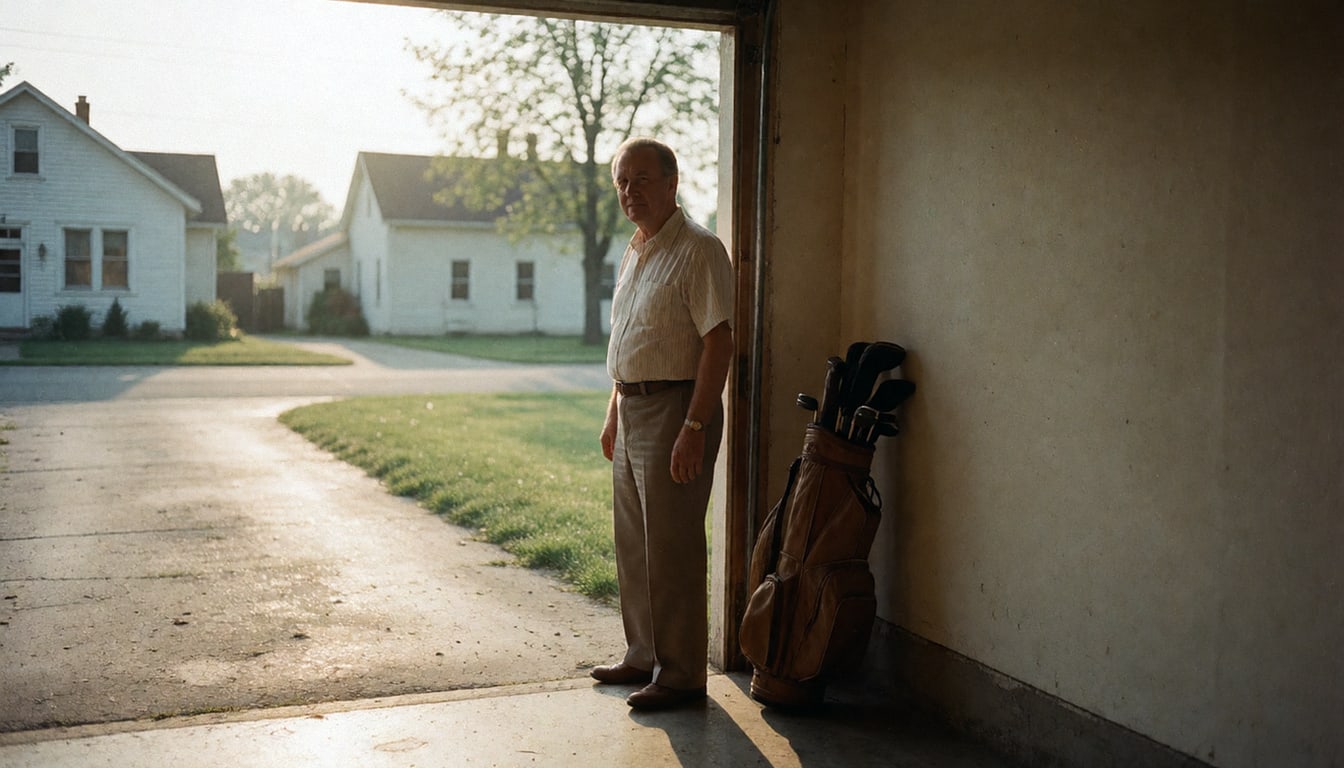

He sold the company on a Thursday in June. The following Monday he played golf, and he kept playing most days for about three weeks.
Then he called me on a Wednesday morning, and it had nothing to do with the wire clearing or where the proceeds were sitting.
At the closing dinner, his oldest son had stood up and given a toast. It was affectionate and it was short. He said his father had worked hard for thirty one years and now he finally got to relax.
That toast sat in him for a month. Thirty one years of six day weeks, and the family summary was that he had been busy and now he could stop. He asked me whether his children had any real idea why he did any of it.
I did not have a good answer for him, because I had never heard him say it either.
Three weeks was the whole plan
Most people know what they are retiring from. Very few know what they are retiring to. He knew the date he was signing and he knew his handicap. Past that, the calendar was blank, and the blankness showed up faster than he expected.
Here is the part that surprised me less than it surprised him. What he was missing was not activity. He had plenty to do. What he was missing was the sense that anyone around the table understood the thirty one years. His children had watched him leave the house early and come home late for their entire childhoods and had drawn their own conclusions about it. He had never corrected them, because nobody had ever asked him a question that would have required it.
That is the silence I see in more families than any other. The parents assume the children understand. The children assume the parents have a plan and that asking about it would look like asking about money. Ten years go by. Twenty. Everyone is polite at Thanksgiving.
So he asked me to get everybody in a room, and I said yes on three conditions.
What everybody had already decided
Six adults on a Saturday morning. Him, his wife, two sons, a daughter, and a son in law who almost did not come because he thought it would be awkward. He was correct for about the first twenty minutes.
Nothing on the table. No documents, no statements, no attorney, no numbers of any kind. Two hours, and I ran it, because a parent cannot chair his own family meeting. The moment he starts, it becomes an announcement.
I asked three questions.
The first one went to the parents. What did you build, and what would you hate to see stop.
He talked for eleven minutes, which was ten more than anyone in that room expected. His own father had lost a business in 1981 and the family moved twice in fourteen months. He remembered packing a kitchen in one night. He said he had built the company so that his children would never pack a house in a hurry. Not one of them had ever heard that. His daughter said, out loud, that she had always assumed he just liked working.
The second question went to the children. What do you think your parents want from the next twenty years.
The answers were vague and they knew it. Travel, maybe. Slow down. Be around the grandkids.
The third question was the one that broke it open. What has each of you been assuming that you have never actually checked.
The middle son said he had spent nine years believing he was expected to take over the company, and had built his whole adult life around resenting a job nobody had ever offered him. His father sat back in his chair like he had been pushed.
The daughter said she had assumed the business money was going to the boys and had made peace with it years ago.
And then his wife said the thing that changed the most. She had wanted, for a long time, to give a set amount away every year while she was still here to see what it did. She had never brought it up because she was sure her husband would think it was reckless with the company not yet sold.
He said he had been waiting for somebody to suggest it.
We scheduled the next one before anyone left. That is the only mechanic that matters. One meeting is a nice Saturday. A standing meeting becomes how the family talks.
How to offer the room
Advisors tell me they would run this if they knew how to bring it up without it sounding heavy. Here is the sequence I use.
Start with the parents alone. Ask them the first question in private and let them answer it badly the first time. Most people have never said out loud why they worked the way they worked, and the first version comes out clumsy. That is fine. You are giving them a rehearsal.
Get their permission and their words for the invitation. One sentence, from them, in their voice. Something like: your mother and I want to tell you what we are actually hoping for, and we want to hear what you have been assuming. Send it as a text if that is how the family talks.
Set the terms in the invitation itself. No documents. No dollar figures. No decisions made in the room. Say it plainly, because every adult child walks in wondering if this is the meeting where they find out the number.
Hold two hours and hold the chair. You ask, they answer. When somebody says something difficult, do not smooth it over and do not move on quickly. The silence after the middle son spoke was maybe fifteen seconds long and it did more work than anything I said all morning.
End with one commitment each and a date for the next one. Small commitments. A phone call, a question somebody wants to ask their father when there is more time.
That is it. Five steps. It is a Vision meeting with the family in the room, and it belongs early in the relationship rather than at the end of one.
The objection you will hear
The parents will say their children will think it is about the inheritance. That objection is handled entirely by the terms. When there are no documents and no figures, everyone in the room figures out within half an hour that the subject is something else, and they relax into it.
The second objection is yours. You are not a family therapist and you should not pretend to be one. What you are doing here is holding time and asking three questions that the family cannot ask itself. If what comes out is bigger than that, you bring in someone whose work it is. That is what Collaborators are for, and knowing where your part ends is a professional strength.
The founder is eighteen months past the closing now. He and his wife give away a fixed amount every year and they choose it together in January. His middle son runs something of his own. The lake place got settled in one conversation because somebody finally said out loud that he did not want it.
He still plays golf. He just does not need it to mean anything.
The values a family lives on get transferred while everyone is still at the table, or they get guessed at afterward from paperwork. Every year that goes by without that room is another year of guessing.